

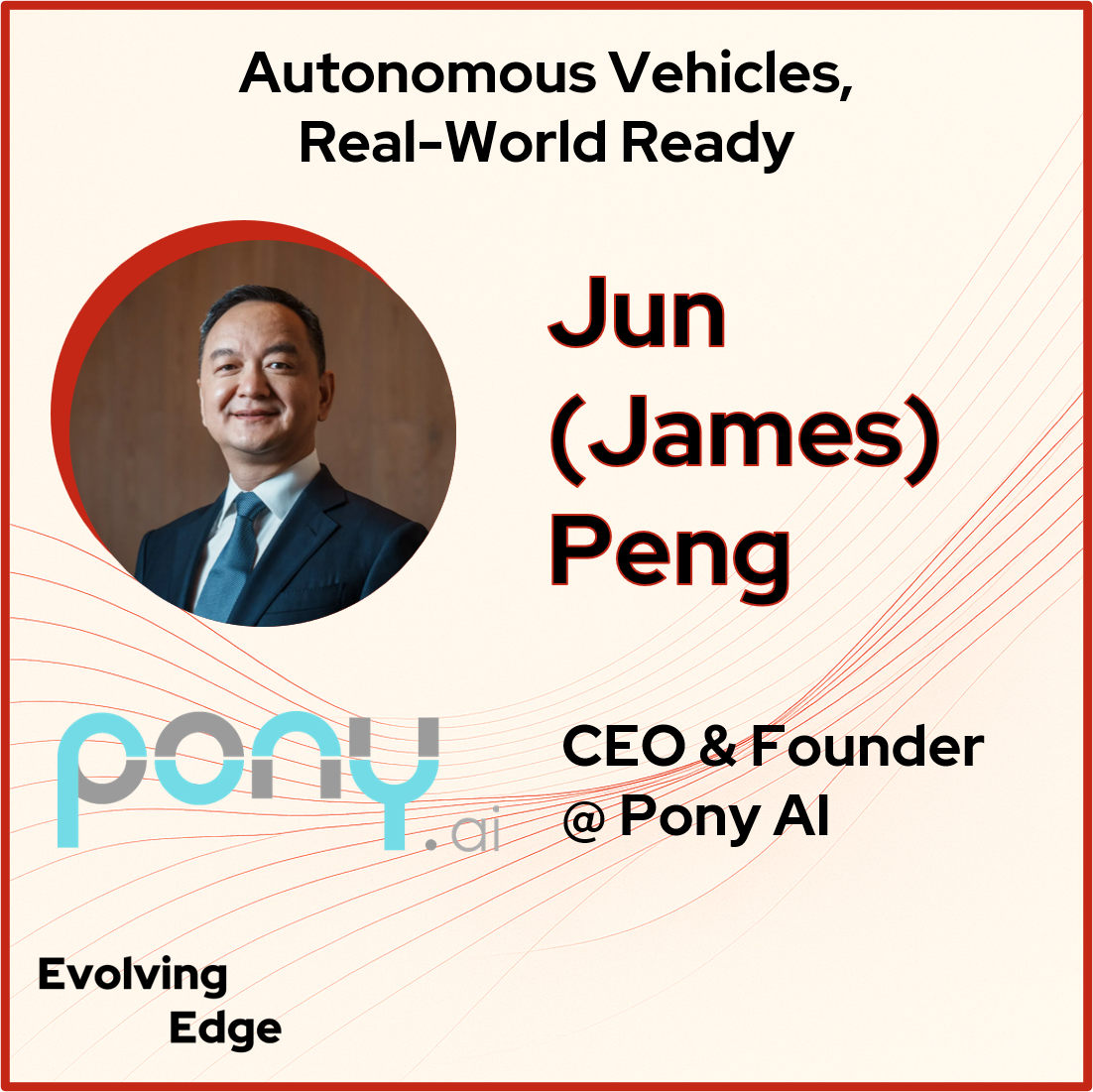
Pony AI is the largest US IPO of autonomous vehicle in 2024. The company’s CEO & Founder, Jun (James) Peng unpacks what it takes to commercialize autonomous vehicles at scale - and how Pony.ai is expanding to global markets.
Q: Pony.ai has seen tremendous success in China. As you explore global expansion, how do you assess "autonomy readiness" in each market? Given the diversity in infrastructure, regulatory maturity, and mobility patterns, how does your go-to-market strategy adapt across geographies?
Jun: We look at a few key things when assessing a market's readiness: regulatory support, infrastructure maturity, and the mobility needs people actually have there. Places like South Korea, the UAE (Dubai), and Luxembourg really stand out because they've made significant progress in several areas: permits for L4 testing; a robust economy and high mobility demand; and smart city visions with future-tech adoption. This makes them great places for pilot programs.
Dubai's a perfect example of a good fit. They have strong infrastructure and a clear plan for building a sustainable public transit that aligns well with what we do. Plus, their "Smart City 2030" goal targeting 25% autonomous transport gives us a concrete path forward: we're planning supervised trials starting in 2025, aiming for smooth integration into their transport system long-term. Luxembourg is similar – their focus on sustainable cities and proactive regulators create excellent conditions for pilots.
Our core tech, the "AI driver," is built to scale globally right from the start. It adapts really well to different environments – like switching to left-side driving in Singapore or handling harsh weather – without needing to be fundamentally rebuilt. This wasn't just theory; it was proven across China's Tier-1 cities with diverse weather conditions. Think Beijing's freezing winters and heavy snowfall, or the intense rainstorms you get in Guangzhou and Shenzhen – our system learned to navigate those successfully. This flexibility is key to our efficient rollout.
So, our go-to-market strategy is all about starting small and proving things step-by-step. We begin with supervised trials in defined areas, like we're planning with Dubai's RTA in 2025. As we demonstrate success, we gradually expand the service area and eventually move to fully driverless operations where people pay fares. This phased approach worked well in China's Tier-1 cities: we proved safety in controlled zones first, then scaled out, and finally removed the safety operators. Crucially, we work very closely with local authorities and partners in each region. Sharing our experience from China – like the 500,000+ hours of fully driverless operations we've done across Beijing, Shanghai, Guangzhou, and Shenzhen – builds the trust needed to move things forward smoothly.
Q: As Pony.ai enters new markets globally, it will likely encounter a mix of global players, regional operators, and local champions. How do you think about differentiation - not just from a technology standpoint, but also from a commercial and regulatory standpoint?
Jun: Our deep experience in China gives us a major edge globally. We operate about 300 robotaxis across Beijing, Shanghai, Guangzhou, and Shenzhen, covering over 2,000 square kilometers – that demonstrates serious scale and capability. We're actually the only company approved for paid robotaxi services in all four of those major cities. And we just launched true 24/7 robotaxi services in Guangzhou and Shenzhen. This didn't happen overnight; it's built on years of working closely with regulators and building a safety record that both authorities and riders trust.
On the tech side, our differentiation comes down to proven scale, safety, real-world validated tech stack. Those 500,000+ driverless hours in China show our safety performance is estimated at ten times better than a human driver. At the heart of our autonomoud driving system is our 7th-gen L4 domain controller – it's production-ready, built to last 10 years or 600,000 km, and the gen-7 AD system got full-vehicle redundancy. We validated the gen-7 domain controller over 2 million km on real roads and managed to cut its cost by 80% compared to the previous version. The latest AD system is modular too, so it adapts to different vehicles and platforms. Our in-house developed foundation model, PonyWorld, keeps making the system smarter and better at handling real world driving cases, using automotive-grade chips.
Commercially, we seek ecosystem synergies by building partnerships along the mobility chain. We team up with global mobility giants like Uber, and key regional players like ComfortDelGro in Singapore or Emile Weber in Luxembourg. This lets us tap into their user base and local know-how, freeing us to focus our resources where it matters most.
Q: The autonomous vehicle value chain spans everything from vehicle manufacturing and ownership, to autonomy software, to downstream business models and end-user engagement. How does Pony.ai think about where to focus - and what to build versus partner on - across this stack?
Jun: Our core focus is laser-sharp: we research, develop, and commercialize autonomous driving technology. To get that tech deployed widely, we strategically partner across the ecosystem – especially with automakers (OEMs), transportation companies (TNCs), and key suppliers.
Here's how that plays out: Vehicle making and ownership? That's handled through our deep partnerships with OEMs like Toyota, GAC, and BAIC. We work together to develop and build robotaxis that come with our self-driving system pre-installed. When it comes to operating the fleet and getting users, we collaborate with fleet operators and tap into platforms like Uber, Amap, Ruqi Mobility, or Tencent Cloud.
This "asset light+AI empowered" model is really efficient. It optimizes our capital, shares the operational benefits, and helps us scale faster. Take our partnership with Shenzhen Xihu Group: we'll jointly deploy over 1,000 of our Gen 7 robotaxis. Xihu brings incredible expertise in managing fleets, handling assets, safety protocols, and service guarantees – and they benefit economically from those operations. Meanwhile, we concentrate on pushing the AI and scaling our robotaxi dispatch and service platforms. This mode of collaboration helps both sides and dramatically speeds up large-scale deployment.
By leveraging our tech and partners' strength for market scale and execution, we optimize resources throughout the whole autonomy stack. Partners like Dubai’s RTA or Emile Weber also offer crucial local market knowledge and regulatory insights, which is invaluable for getting approvals and tailoring vehicles or services quickly to fit specific needs.
Q: On a more personal note - as an engineer-turned-CEO, how has your perspective evolved when it comes to balancing product innovation with commercial expansion? What has been the most challenging lesson in leading an autonomous driving company through both phases?
Jun: Moving from engineer to CEO shifted my perspective pretty fundamentally. Early on, innovation was almost the end goal itself – chasing the perfect sensor fusion or solving the toughest edge cases for our "AI driver".
Taking Pony.ai through commercialization changed that: now, I see innovation as a crucial path to creating real, scalable value. Take our 7th-gen L4 AD system for example. It wasn't just a tech breakthrough; the 70% BOM cost reduction and automotive-grade durability were critical design choices to enable mass deployment.
The toughest lesson? Dealing with the time mismatch. Building safe autonomous driving is a marathon – it takes immense R&D effort, like validating your system over 500,000 driverless hours. But running a company demands you move at a sprint commercially to keep things going. Balancing those timelines meant making hard trade-offs. We learned the hard way that favorable policies aren't automatic; you have to actively cultivate them. Engaging regulators early and actively was key. By aligning our tech innovation with national or regional development goals, we turned policies into accelerants for both innovation and business growth.
In short, I think the essence is shifting from the engineer's drive for zero-fail systems to the CEO's job of juggling parallel paths – where tech breakthroughs fuel the business model, and the commercial success funds the next wave of innovation.