

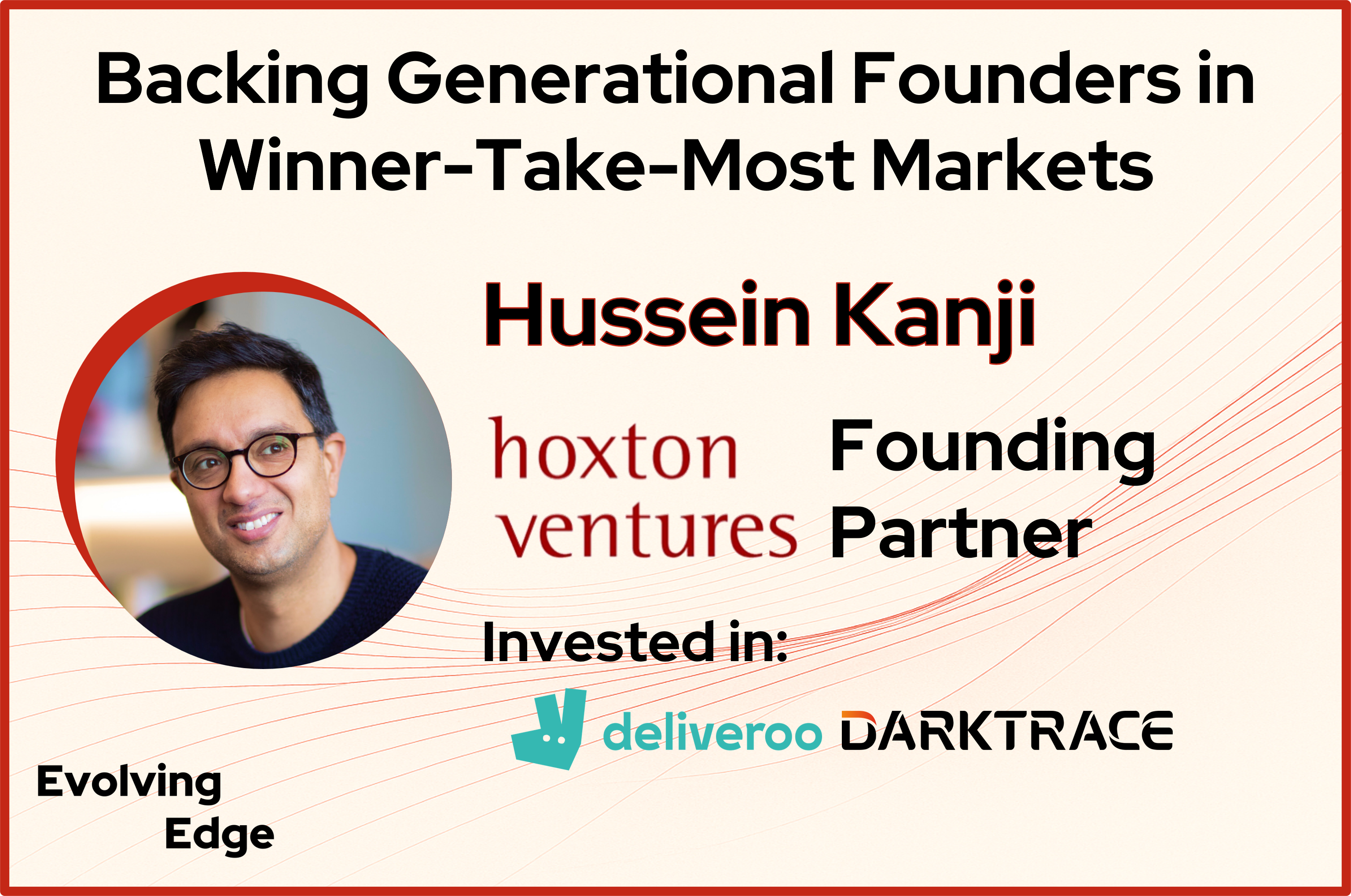
Hussein Kanji is the Founding Partner of Hoxton Ventures, one of Europe’s most respected VCs, known for backing generational companies like Deliveroo and Darktrace at their earliest stages.
Q: Hussein, before we dive in, could you share a quick overview of your journey and what Hoxton Ventures is about?
Hussein: Hoxton started with what was considered a slightly rogue idea at the time: building a truly early-stage venture firm in Europe, based in London, but with the ambition and operating style of top West Coast firms. The goal was simple - invest early, be proactive, sit on boards, and help European companies win mindshare and customers in the U.S.
When we started around 2012–2013, almost no one in Europe was doing that at seed or Series A. Today, our latest announced fund is ~$200M, up from a ~$28M first fund. Total amount raised across multiple funds is ~$450m. Our portfolio is roughly 50% enterprise software, 30–35% deep tech, and the rest consumer. We invest across Europe - about 50% UK, 25% Western Europe, and 25% Eastern Europe, which we’re particularly bullish on due to the depth of engineering talent.
Q: You’ve backed companies like Deliveroo and Darktrace at very early stages. How do you assess founders when there’s little revenue and often no product-market fit yet?
Hussein: It depends on the category. In deep tech, the invention itself can be the signal - something genuinely novel that few others could build. That gives you a clear anchor.
In other cases, like Deliveroo, it was triggered by traction. When I first met Will Shu (Founder of Deliveroo), I was actually quite skeptical. At the time, food delivery didn’t obviously look like a massive market, and the version of the idea that existed then felt quite narrow. My initial instinct was that it might be too small to justify the kind of outcome venture investors look for.
But then the product launched - and the data changed everything.
Very quickly, Deliveroo was growing around 5–7% week-on-week, which is an extraordinary rate at that stage.
What stood out just as much was how Will was operating. He was doing deliveries himself, running the company out of a small apartment, deeply involved in every part of the business. There was no separation between “founder” and “operator.” He was living inside the problem.
At that point, the original concerns about market size mattered less. When you see:
Strong, sustained early growth, and
A founder who is completely immersed in execution
you pay attention. The combination is powerful.
That’s also why I don’t believe there’s a single template for early-stage investing. In Deliveroo’s case, it wasn’t deep tech or a breakthrough invention that drove the decision - it was traction and founder commitment showing up very clearly, very early.
At the end of the day, checks get written for different reasons: breakthrough innovation, early traction, or occasionally sheer founder quality. There’s no single formula.
Q: Many tech categories feel “winner-take-most.” How do you think about market structure?
Hussein: Most global technology markets are winner-take-most by default, unless there’s a strong reason they aren’t - things like regulation or geographic fragmentation.
Social networks are the classic example. There were many strong local players around the world, but the vast majority of the value ended up accruing to one global winner. You see similar dynamics in enterprise software. In CRM, for instance, there are lots of vendors, but most of the market cap sits with Salesforce.
That doesn’t mean you can’t build a good business as a number two or three. You can. Markets are often large enough for that. But if you’re aiming for truly outsized outcomes, you generally want to back the company that has a real shot at being number one.
The difference between a very large outcome and a good one can be enormous - orders of magnitude apart.
Q: For founders outside the U.S., how should they think about competing globally against Silicon Valley companies?
Hussein: In reality, you’re usually optimizing either for downside protection or for upside potential - and the two lead to very different outcomes.
If you optimize for downside, you focus on building a strong regional business where you have local advantages and less direct competition. That can work, and it can produce good companies. But it also tends to cap the size of the outcome, because it assumes global players won’t move in aggressively.
If you want to build a truly massive company, you eventually have to compete where the category is being defined. In most technology markets, that means the U.S. market. It’s not just about size - it’s where customer expectations, pricing, and narratives are set.
Stripe is a good example. The founders were Irish, but they moved early and oriented the company around the U.S. Had they stayed in Ireland and optimized locally first, the outcome would almost certainly have been smaller.
My bias is that if you know you’re playing for the biggest outcomes, it’s often better to make that decision early, before the company hardens around a more local optimum.
Q: In AI, many people argue that product moats no longer exist—that velocity matters more than defensibility. Do you agree?
Hussein: I actually think moats matter more than ever, not less.
Right now, the industry is very focused on short-term signals: fast revenue, fast markups, fast fundraising. AI makes it easier than ever to show early traction. But early traction doesn’t necessarily translate into durable value.
We’ve seen this before. In periods where technology is moving very quickly, entire business models can disappear almost overnight. Companies that looked incredibly strong early on simply didn’t persist.
If you don’t have a real moat - whether that’s data, distribution, deep integration, or something else that compounds over time - then your claim to terminal value is fragile. You might grow quickly, but that doesn’t mean the business will still matter in ten years.
History has a lot of examples of this, from the dot-com era through to more recent cycles.
Q: Given all that uncertainty, which areas are you most excited about right now?
Hussein: Deep tech remains very exciting for us. Areas like materials science, for example - companies working on recreating rare earth materials in labs - are genuinely interesting.
Robotics is another area where we’re seeing step-function improvements. It was relatively stagnant for a long time, but progress is accelerating now, with noticeable improvements every six months or so.
That said, as venture investors, we don’t pretend to know exactly where the next big winner will come from. Our job is to stay close to builders, build a portfolio that reflects uncertainty, and be ready to recognize real breakthroughs when they appear.