

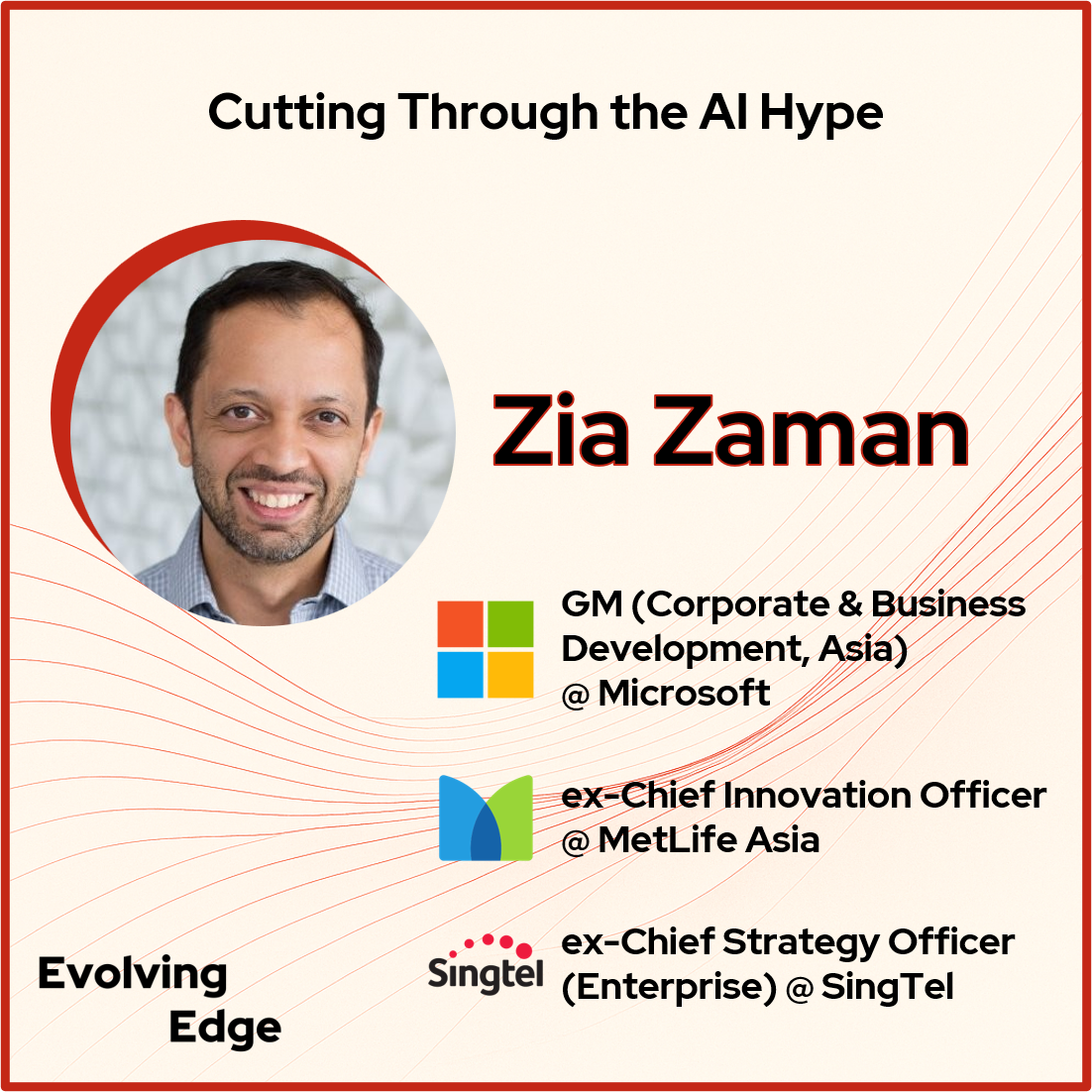
Zia has seen it all - from scaling innovation at global giants (e.g. MetLife, Singtel) to helping enterprises rethink how they work in the AI era. Now at Microsoft as GM (Corporate & Business Development, Asia), he’s leading investing, M&A and strategic partnerships that enhance Microsoft’s product, ecosystem and market expansion in Asia.
In this chapter of Evolving Edge, Zia opens up about what actually drives impact, how large companies can move faster, and why it all comes down to solving problems that matter.
Q: You’ve seen how AI adoption varies across Asia. What’s your advice for AI companies approaching enterprise clients across the region?
Zia: I will focus more on B2B. The most common mistake AI companies make in Asia is starting with geography. That’s backwards. Region is the fourth variable.
Start by asking:
What sector are you in?
What problem are you solving?
What is the business metric you can move?
Who are your ideal customers within those parameters?
Then, tailor your pitch around the specific business problem your product addresses. Don’t lead with “we’re based in Singapore” or “we’ve built X.” Instead, say: “We help reduce X cost by 30% in financial institutions.” Frame your product as a lever to make the decision-maker a hero in their business.
And go after the biggest possible budget. Selling to SMEs may seem easy, but it’s much harder to scale. I always say: go for the largest companies in your sector who face the same pain point. Sell a million-dollar product to 20 clients - not a $10 product to 2 million.
City-level marketing is also underrated. In India, for example, the top 50 million consumers live in a handful of cities. You don’t need to win the whole country - just win Mumbai, Delhi, Bangalore. This is what the top Chinese tech companies do: go after mega-cities first.
Q: For traditional enterprises in regulated industries - especially in Asia - what are the main barriers to AI adoption today?
Zia: Honestly? The barriers are falling away quickly. The only real challenge left is mindset.
If you’re not already using AI for:
Customer service and support,
Coding,
Analytics,
...then you’re already behind.
AI should be helping employees go home earlier. It should be reducing call center load by up to 80%. It should be writing 40% of your code. If your knowledge workers aren’t saving time, you’re not efficient. Your revenue per employee will be far below where it could be.
Agent onboarding in insurance is a great example. The most important KPI is how fast an agent gets to their second or third sale. AI can accelerate that ramp-up time dramatically - boosting retention and sales outcomes.
So ask yourself: what’s the reason not to use AI? Because right now, the companies who are hesitating are losing competitive ground.
Q: When evaluating whether to build, partner, or buy in AI, what’s your framework?
Zia: I actually avoid the “build vs. partner vs. buy” framing.
Instead, I ask: Where in the AI stack do you really have the right to win?
Don’t kid yourself into thinking you can compete at the infrastructure level. You’re not going to beat NVIDIA or OpenAI. Very few companies have the capital, talent, or staying power to play at that level.
Instead, find your edge in vertical execution. Focus on a specific workflow in a specific sector where your AI can add measurable value. Maybe it’s underwriting. Maybe it’s hospital logistics. Maybe it’s customer onboarding. That’s where most companies can - and should - win.
For most companies, the best strategy is to become excellent users of AI - like how businesses once adopted electricity, steam, or software. Use agentic AI and inference engines to solve real business problems. That’s where transformation happens.
Q: With so much noise in the market, how do you personally separate AI hype from actual value?
Zia: I look for evidence of time savings, cost reduction, and revenue uplift.
If something used to take two weeks and now takes a day - that’s real. If you can increase your sales conversion by improving how agents are trained - that’s real. If 80% of your customer support tickets are now resolved automatically - that’s real.
These are not theoretical improvements. They’re happening now in smart organizations. And they’re dramatically improving operational efficiency.
AI is becoming the difference between companies who scale and those who stall. It’s not about vanity metrics. It’s about outcomes.
Q: Final words for AI founders and investors?
Zia: I hope more early-stage investors focus on real value creation. Forget what’s trendy. Don’t chase mass consumer apps just because they scaled in China. Invest in companies that solve one problem 10% better than anyone else - especially in enterprise.
And for founders: Pick the right workflow. Make your product indispensable to that workflow. Show measurable impact fast.
That’s the surest path to relevance - and resilience.