

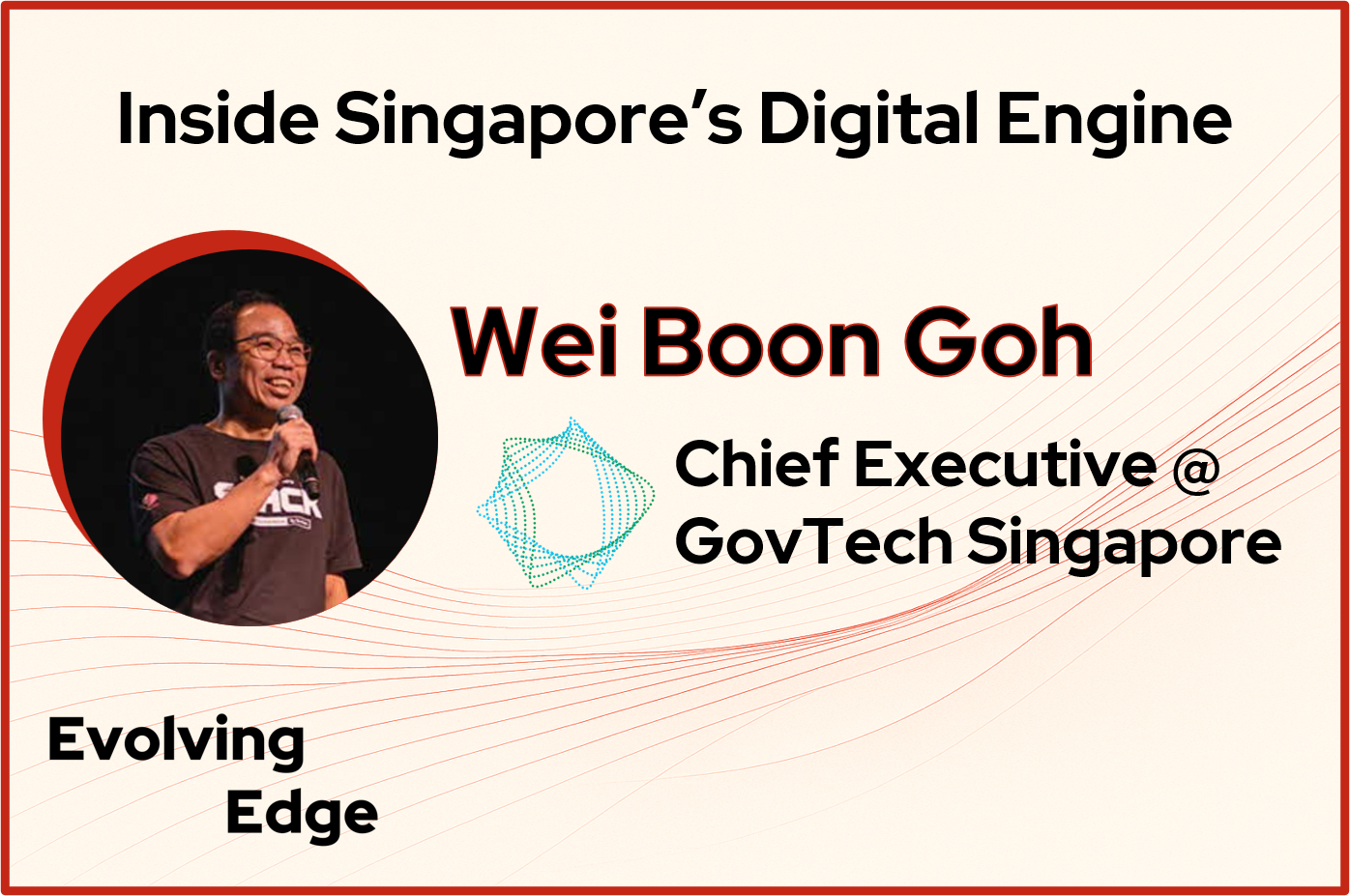
Chief Executive of GovTech Singapore, Wei Boon Goh, brings a rare blend of technical depth and strategic clarity to one of the world’s most admired public digital agencies. A former cybersecurity leader at the Ministry of Defence, Wei Boon now oversees an agency building platforms that power everyday life in Singapore.
In this Evolving Edge chapter, Wei Boon shares how GovTech decides what to build, how AI is being deployed in the public sector, and why capability-building is key to digital government.
Q: You have a technical background, which is uncommon among public sector leaders. What brought you to GovTech?
Wei Boon: I spent 26 years in the Ministry of Defence, working on a broad range of technical challenges - primarily in cybersecurity. When GovTech was undergoing a leadership renewal, there was a sense that the organisation could benefit from someone with deep hands-on engineering and systems experience to complement its strong strategic foundation.
They approached me because there aren’t many public sector leaders with that profile. Most technologists in government are in defence-related agencies. I agreed to take on the role because I saw the opportunity to shape how Singapore delivers technology at scale - not just for defence, but across society.
Q: GovTech has built several national platforms in-house, but also partners with external parties when needed. What’s your decision framework for when to build internally vs. when to co-develop or buy from external tech players?
Wei Boon: The most important consideration is the criticality of the product to Singapore. Singpass, for instance, is the foundation to how citizens authenticate themselves across hundreds of government and commercial services. It carries significant security and trust implications, so we build it entirely in-house and retain full control. The same goes for our anti-scam systems, where methodologies and algorithms must remain confidential.
The second lens is scalability. If a platform is going to be used across multiple agencies, it’s far more efficient for GovTech to build it once and make it available as a shared service. A good example is our Q&A AI bot that enables officers to interact with lengthy policy documents across departments.
For less critical, agency-specific tools, we often co-develop or fully outsource to vendors. But even then, we’re deliberate in our choices. We work with multinational tech companies, but also with smaller, agile local firms. Ultimately, the key criteria are having the right capabilities and capacity to deliver, not company size.
Q: Governments are often viewed as slow and rigid. Yet Singapore has a reputation for being digitally agile. How does GovTech strike the right balance between innovation and stability?
Wei Boon: It’s definitely a challenge, but there are three things that help us. First, strong political will. The Smart Nation initiative was championed by our previous Prime Minister and gave GovTech a powerful mandate.
Second, we invested in building internal capabilities. If you want to know what “good” looks like, you have to build it yourself. That’s why we brought in software engineers, product managers, UX designers - so we wouldn’t just be a project manager outsourcing everything.
Third, we help agencies become more self-sufficient. Every ministry and statutory board has unique needs, and we want them to take ownership of their digital products. So we build the platforms, tools, and design systems that let them move fast without compromising quality or stability. We’re making digital capability a whole-of-government skill set, not a central bottleneck.
Q: AI is evolving quickly. Where do you see the most immediate impact in government?
Wei Boon: Our first priority was safety. We didn’t want officers pasting sensitive information into consumer tools like ChatGPT. So we partnered with AI companies to create a secure, sandboxed environment where prompts wouldn’t be stored or used for training. That helped unlock usage across the public service without compromising trust.
Then we started building use cases. One example is generating student testimonials. Teachers normally spend 20–30 minutes writing each one. Now with just a few bullet points, AI can draft a solid first version, potentially saving hours of effort during graduation season.
Another is document Q&A bots. Public policy documents are dense and long. Officers can now upload them and use chat interfaces to extract key info. These are practical, high-ROI wins. They don’t require major system changes, but deliver real productivity gains.
We also launched hackathons to bridge business and engineering teams. These events bring together public officers who have ideas or problems to solve with engineers who can quickly build prototypes. Once a prototype demonstrates value, we assess whether it’s suitable for scale. This model has not only accelerated innovation, but also created ownership and confidence across the ecosystem.
Q: What about longer-term AI applications?
Wei Boon: The possibilities are limitless, limited only by our imagination.
For example, we’re seeing very promising pilots in education. One team built a prototype that uses AI to grade chemistry papers. It was trained on past test answers and showed high accuracy. It’s still early, but it shows that AI can augment—and perhaps eventually automate—some of the most time-consuming administrative work in teaching.
Another exciting prototype is “Language Buddy.” It’s designed to help students practise conversational Mandarin by chatting with a friendly AI. As a parent, I know how hard it is to get kids to speak Mandarin at home. This could be a fun, effective way to reinforce language learning.
And then there are creative, unconventional ideas. One team prototyped a virtual memorial system - where you can pay respects to deceased loved ones online and even “chat” with an AI that has been trained on their writings. It’s not for everyone, but it opens up new forms of digital remembrance.
Q: Beyond AI, what other technologies excite you?
Wei Boon: I’m particularly excited about smart city infrastructure and digital twins. At GovTech, we’ve developed the Open Digital Platform, a foundational layer that enables interoperability across cyber-physical systems. We’ve already seen this in action within the built environment, where we’ve connected systems like sensors, elevators, HVAC, and robots into a unified, intelligent network. For example, if a robot needs to move between floors, it can autonomously call the elevator. If a room gets too hot, the system can automatically adjust the air-conditioning with no human intervention needed. It’s about making public buildings more responsive, sustainable, and autonomous.
We’re also working with agencies like MPA and JTC on digital twins - virtual replicas of ports and industrial estates that support real-time simulation, scenario planning, and environmental control. These tools will be game changers for operational command, resource optimisation, and long-term urban planning.
Together, these efforts show how smart infrastructure isn’t just about technology - it’s about using tech as a force for public good, creating spaces that are more efficient, livable, and future-ready.
Q: Any closing thoughts?
Wei Boon: Singapore’s digital government is only possible because we’ve invested in deep technical capabilities, earned public trust, and had the courage to lead decisively. From generative AI to robotics and digital twins, we’re not just watching from the sidelines - we’re shaping what comes next.
But it’s not innovation for its own sake. We build technology to serve people - to improve lives, strengthen communities, and make public service more responsive and inclusive. That’s what tech for public good means to us.
And to do that well, we must always be building. That mindset of continuous experimentation, delivery and improvement is what will keep us moving forward.