

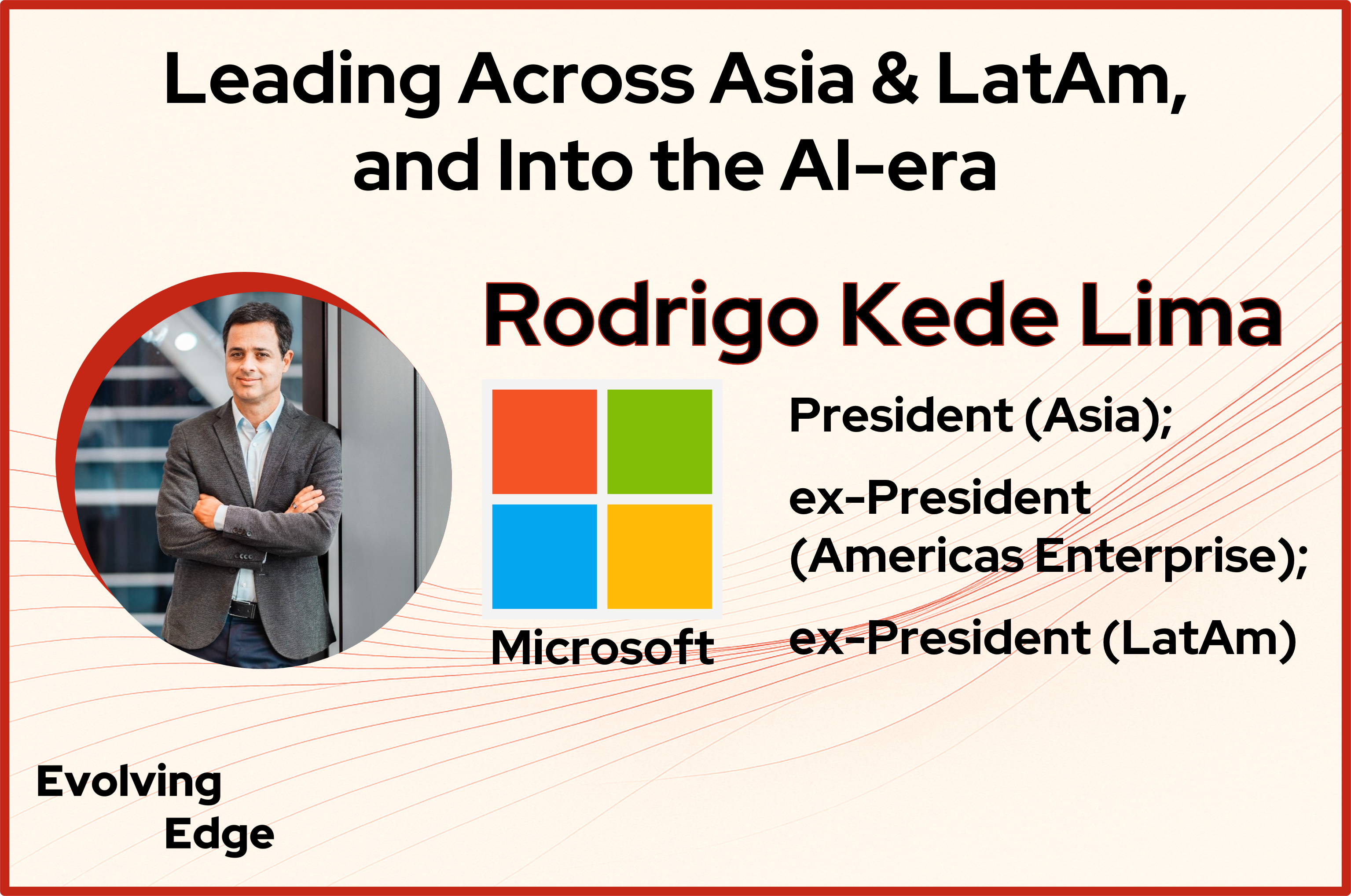
Rodrigo is currently President (Asia) at Microsoft. Previously, he served as President (Americas Enterprise) and President (LatAm), leading the company across some of the world’s most complex regions. In this conversation, we spoke about leading at scale across diverse regions and cultures, and how AI is reshaping enterprise workflows.
Q: Rodrigo, could you start by sharing your journey - and how you ended up leading Microsoft in Asia?
Rodrigo: I never really planned my career in a linear way. I grew up in Brazil and originally thought I’d become a medical doctor, but at the last minute switched to engineering. I studied industrial and mechanical engineering, and somewhat unexpectedly began my career in finance at IBM.
Jobs were scarce at the time, so I leaned in and learned finance properly, even completing a master’s in the field. I spent more than a decade in finance roles, eventually becoming CFO for Brazil and later Latin America.
That background became a real differentiator. I’ve always been passionate about technology, but finance gave me a structural lens on how businesses actually work - allowing me to bridge both worlds.
In 2016, I moved to the U.S. with my family, looking for a new challenge. Not long after, Microsoft approached me with an opportunity to lead in LatAm: a region they felt held untapped potential. Given its complexity and pace, it felt like the right next chapter.
Q: You’ve led Microsoft across Latin America, the U.S. enterprise business, and now Asia. How does the nature of operating and leading at scale differ across these regions?
Rodrigo: There are both similarities and very real differences.
In Latin America, you’re dealing with over 30 countries - but mostly just two languages: Portuguese and Spanish. That reduces complexity significantly. Asia is fundamentally different. Languages, cultures, and business norms vary dramatically between Japan, China, Southeast Asia, and India. The cultural intersections are much smaller, which means you have to connect locally in very different ways.
Another major difference is economic dependency. Historically, Latin America has been closely tied to the U.S. and Europe. Asia is far more independent - economically and in terms of identity. If the U.S. and Europe slow down, Latin America feels it immediately. The world, however, cannot simply “shut down” Asia.
What’s exciting in Asia is that innovation is increasingly local. Companies are being built here and scaling globally. That fundamentally changes the GTM dynamic.
Q: How do you get highly diverse teams across cultures and time zones to truly work as one?
Rodrigo: The most important thing I’ve learned is to listen first.
People often over-index on differences - but in reality, we’re far more similar than we think. We all have families, ambitions, and pride in our work. When I brought my Asia leadership team to Seattle recently, people at HQ were surprised by how close-knit we were — how much we trusted and defended each other.
That trust comes from curiosity and humility. When you land in a new market, you must assume that what worked for you over the past ten years may not be the best answer anymore. That’s not a natural muscle for leaders - but it’s essential.
Q: Microsoft is at the forefront of AI. Where do you see enterprise AI adoption taking hold first, and why?
Rodrigo: AI is fundamentally different from past technology waves. The PC, internet, and cloud were largely about democratizing technology - making powerful tools cheaper and more accessible. AI, however, is about democratizing knowledge.
For the first time, expertise that once sat with a small group of specialists can be made available, on demand, to anyone inside an organization. That shift has far-reaching implications for how work gets done, how decisions are made, and how value is created.
In the near term, adoption is happening fastest where there’s a clear combination of three factors: labor‑intensive processes, large volumes of data or documents, and well‑defined rules or frameworks. That’s why areas like customer support, compliance, KYC, and financial crime are seeing rapid traction - the problems are well scoped, the data already exists, and the impact is easy to measure.
The ROI in these use cases is very clear. Machines already outperform humans in many of these workflows - not because people aren’t capable, but because AI doesn’t get tired, doesn’t miss details, and can operate consistently at massive scale. Once organizations see that impact in one function, it becomes much easier to expand AI into adjacent workflows.
Q: What do you think is the biggest challenge enterprises face in adopting AI meaningfully?
Rodrigo: The challenge isn’t experimentation - it’s integration.
Many enterprises are running dozens, sometimes hundreds, of AI pilots. The problem is that these pilots often live on the edges of the organization, disconnected from core systems, incentives, and decision-making. As a result, they generate excitement, but very little sustained impact.
AI’s real value emerges only when it is deeply embedded into day-to-day workflows - not as a standalone tool, but as an invisible layer that augments how people actually work. Over time, every employee will have an AI companion, much like everyone has Excel today. People will build agents the way they once built spreadsheets - to manage information, automate repetitive tasks, and support better decisions in real time.
This shift requires enterprises to rethink processes end to end. It’s not about adding AI on top of existing workflows, but redesigning those workflows with AI at the core - redefining roles, changing handoffs, and updating how performance is measured.
The companies that ultimately win won’t be the ones running the most pilots. They’ll be the ones willing to do the harder work of re‑architecting their operating models around AI, so that productivity gains and decision quality compound across the organization.