

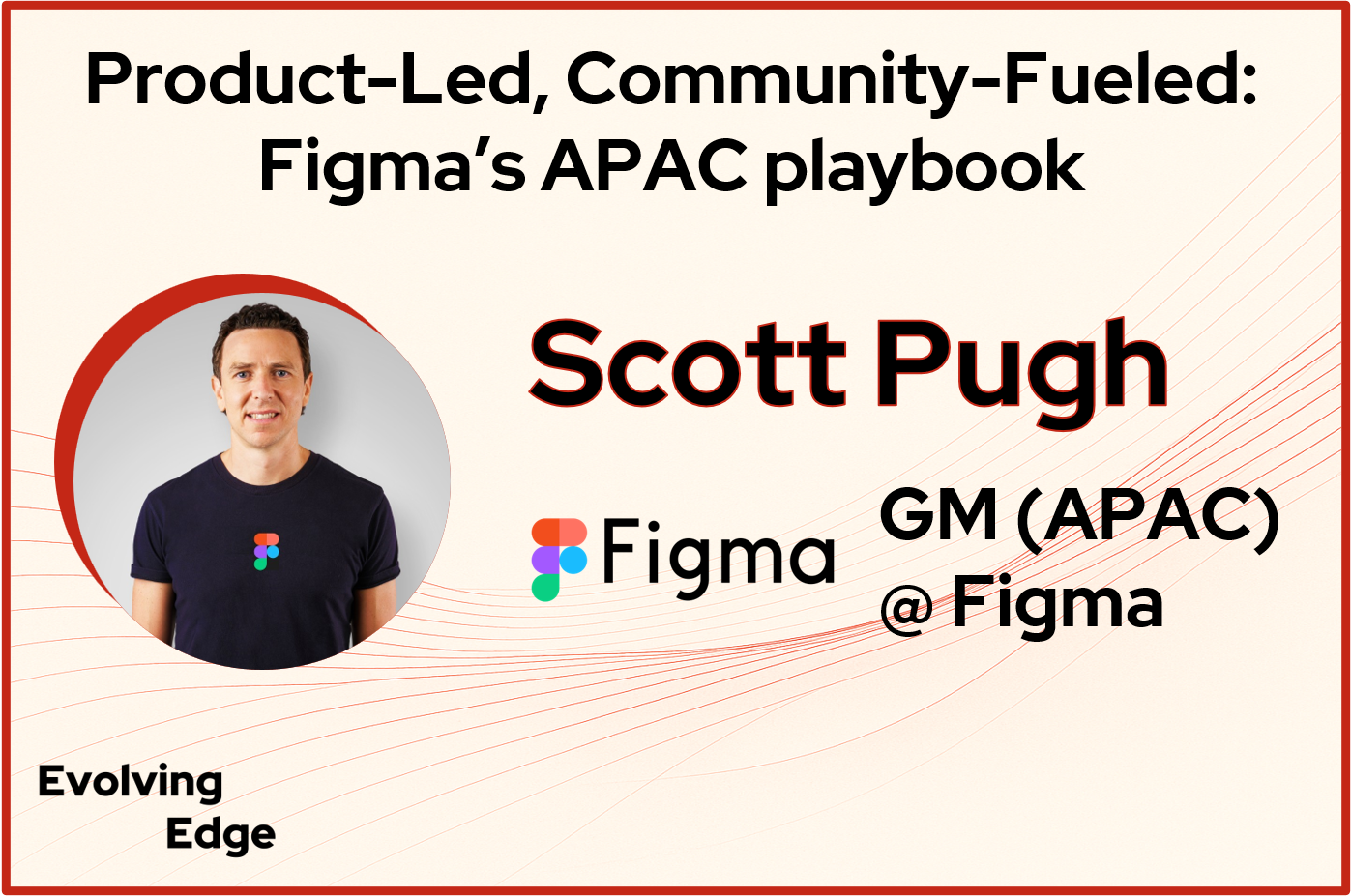
Fresh off an IPO in July 2025, Figma has big plans for global expansion. Scott Pugh, Figma’s GM (APAC), joined as the company’s first employee in the region three years ago. Since then, he’s built Figma’s go-to-market organization from scratch - localizing playbooks, cultivating community, and helping the world’s biggest brands reimagine collaboration.
In this conversation, Scott reflects on the evolution of design in APAC, the interplay between product-led and community-led growth, and how Figma balances speed, scale, and creativity across one of its fastest-growing regions.
Q: Before we dive in, could you give us a quick introduction - who you are, how you came to join Figma, and what you do today?
Scott: Sure. I’ve been at Figma for three years now - in fact, it was my three-year anniversary just last week. It’s been a phenomenal journey, both personally and for the company.
I joined as Figma’s first employee in Asia-Pacific, so I’ve had the opportunity to build the entire go-to-market function here from scratch - hiring the team, shaping our regional strategy, and helping some of the most innovative organizations transform how they build products.
What’s been incredible to see is not just how Figma has evolved as a company, but how the entire product development lifecycle itself has transformed. The way teams design, collaborate, and ship products today looks completely different from a few years ago - and Figma’s platform has evolved in lockstep to support that innovation.
Before Figma, I was at Mixpanel, where I built and scaled the APAC business for their product analytics platform. Prior to that, I spent seven years at LinkedIn - I was their first employee in Hong Kong before moving to Singapore, where I’ve now been based for about a decade.
Q: What were some of the key inflection points you experienced while building Figma’s presence across Asia-Pacific?
Scott: When you’re scaling a business in a region as diverse as APAC, the first thing is understanding where you already have product–market fit - where the early signals show you’ve found strong traction, a loyal user base, and those initial “beachhead” customers you can build on.
Figma has been product-led from day one. Our platform was designed for collaboration - people bring others in to view, comment, and co-create - so virality is built into the product itself. That natural network effect fits perfectly with a product-led growth motion.
When I joined three years ago, Figma was already nine years old and had a sizable user base in Asia-Pacific, but most of that demand was being served from North America. To truly scale, we needed to be closer to our customers - meeting them face-to-face, understanding local workflows, and building real relationships in-market.
Since then, we’ve not only grown a strong customer base but also an incredible community. We often talk about “community-led growth” alongside product-led growth, because the design community in this region is so vibrant, generous, and collaborative. Designers here love to share what they’ve learned, and Figma has been able to create the platform and environment to bring that energy together.
So, if I had to pinpoint the inflection points, they’re really threefold:
Recognizing where product–market fit already existed and doubling down there.
Localizing presence to engage customers directly across key markets.
Empowering community-led momentum to scale organically beyond what any traditional GTM engine could achieve.
Q: Figma has strong product-led and community-led roots, but enterprise is often seen as a very different game. How do you reconcile that DNA with scaling in the enterprise space - especially across markets with different levels of tech maturity?
Scott: I’d actually say we’re not moving into the enterprise space - we’re already deeply embedded there. Figma today is a foundational tool for roughly 95% of the Fortune 500 and 78% of the Forbes Global 2000. We’ve achieved that scale through a product-led motion, not by abandoning it.
It started organically. Designers within enterprises began using Figma alongside other tools. They loved the experience, started inviting teammates, and soon, entire product and design orgs were collaborating on Figma. That bottom-up momentum created internal champions - heads of design, principal designers, or product leaders - who drove wider adoption across their companies. Often, it began with a simple self-serve account before formalizing into enterprise contracts.
The beauty of Figma’s model is that it reflects how modern work actually spreads - one enthusiastic user at a time. But at scale, enterprise adoption naturally brings more complexity. You have multiple stakeholders - legal, compliance, security, procurement - all part of the buying decision. At that point, you need an enterprise GTM motion layered on top of the product-led foundation.
So for us, product-led growth remains the entry point, but sales becomes the multiplier. As I like to put it: product-led growth opens doors, but sales teams close them. It’s that combination that allows Figma to remain true to its collaborative roots while scaling as a critical platform across the world’s largest organizations.
Q: From your perspective, how is AI transforming the way people design and create - particularly across such a diverse region like Asia-Pacific?
Scott: The shift has been dramatic. In just the last six months, the way people build digital products has completely changed. The barrier to entry is almost gone - anyone with an idea can now prototype a product in days and pitch it with something tangible. It’s the most exciting time I’ve seen in tech in my 20 years.
Figma is uniquely positioned to support this new wave of AI creativity. We started as a UI/UX design tool, but the platform has evolved fast - with FigJam for ideation, Figma Design for high-fidelity work, Dev Mode for seamless handoff, and now Figma Make, which lets users go from prompt to product directly in code.
What makes it powerful is context. Companies already build their design systems in Figma, so when they use Make, the AI generates prototypes that are on-brand and consistent with their existing design language.
AI will make it easier than ever to build - but with that, quantity will explode, and quality could suffer. That’s why we believe design becomes the ultimate differentiator. In a world where AI can generate anything, the best products will still stand out by design.
Q: Across such a diverse region, do you see differences in how countries or industries are adopting AI and Figma’s tools, or is usage relatively consistent?
Scott: There are definitely differences - both by country and by industry. Markets vary in their maturity around AI adoption, design systems, and how they build products. But more than geography, we actually see the biggest contrasts by vertical.
Digital natives and startups tend to move fast - they experiment, iterate, and adopt new tools like Figma’s AI features almost immediately. In contrast, sectors like banking and financial services are more cautious. Some, like Commonwealth Bank of Australia, are leading the way and deeply engaged with our AI capabilities, but others are still in early stages - it’s a bit like turning a cruise ship; it just takes more time.
Regionally, it’s impossible to treat APAC as one market. It’s really five or six distinct subregions with different levels of maturity. Take India, for example - we’re opening our first office there in November. It’s a developer-led market with incredibly sophisticated teams who push Figma’s boundaries, building custom plugins and workflows that often inspire what we later bring into the native platform.
So yes, adoption patterns differ - but across all markets, the direction is the same. Whether it’s startups in Jakarta or banks in Tokyo, everyone’s moving toward faster, more collaborative, and increasingly AI-powered ways of designing and building products.