

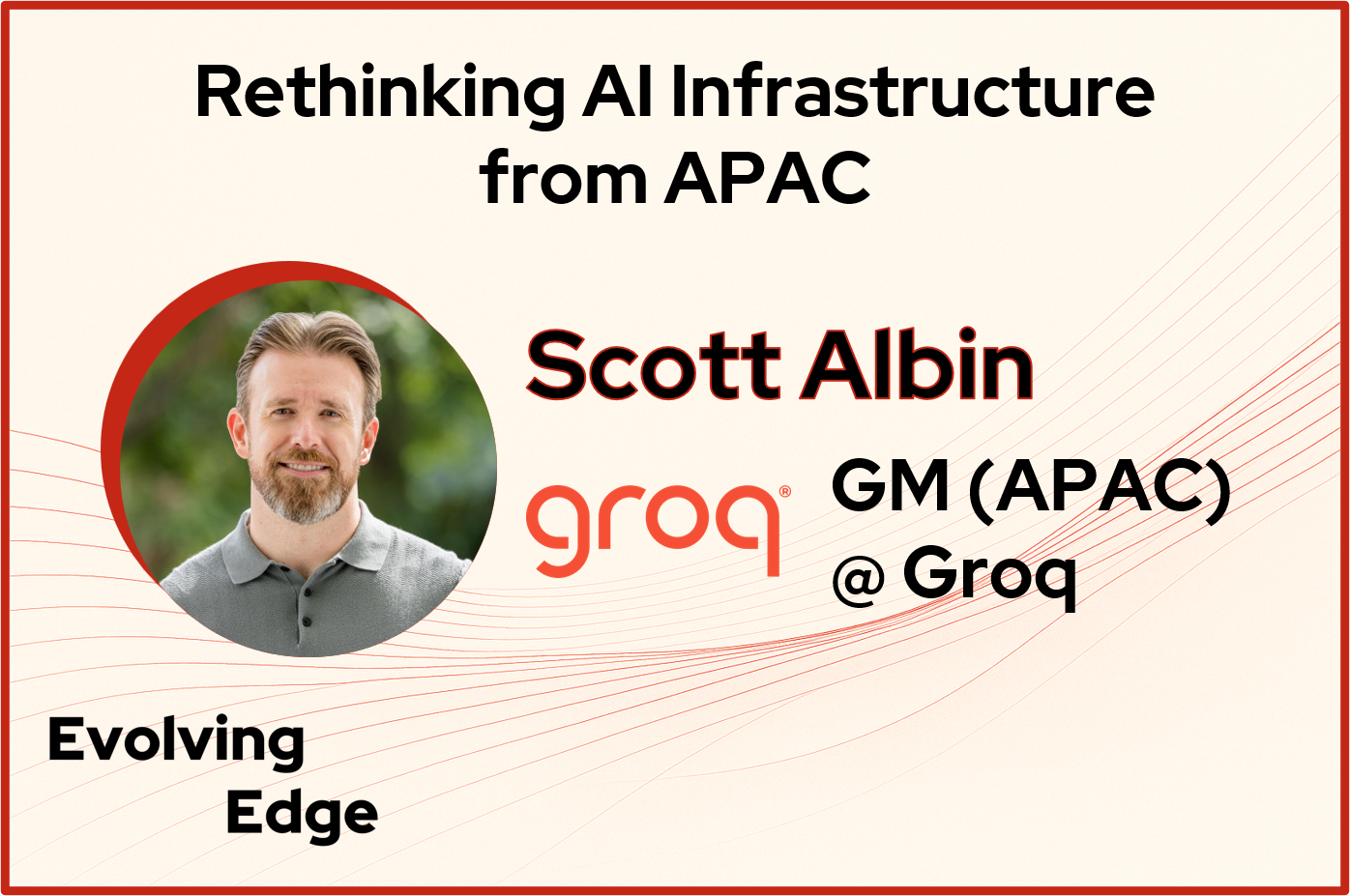
With 2M+ developers on its platform and a rumored US$6B valuation, Groq is emerging as a key Nvidia rival. Groq is building AI-native chips with ultra-low latency architecture for inference, enabling new real-time LLMs, embedded AI agents, and latency-sensitive workflows.
GM (APAC), Scott Albin, is at the center of Groq's global ambition.
In this chapter of Evolving Edge, Scott shares why the future of AI in APAC will be driven by inference, how Groq’s cost and performance advantages are winning over early AI adopters, and what makes their go-to-market so unique.
Q: Let’s start with your journey - how did you end up at Groq?
Scott: My career has always been in software and services. First in large-scale enterprise IT systems, then moving into analytics, machine learning, and now AI. The core principles are similar, even if the labels have changed.
I came to Groq initially as an investor in the Series D round. In discussions with the team, I learned Groq already had a meaningful base of early adopters in Asia. Having spent nearly nine years in Singapore and four in Australia, I understood the regional landscape and began suggesting how to capture that demand. That evolved into leading the APAC business from January this year.
Q: For readers who may not know - what exactly does Groq do that’s so different?
Scott: Most AI infrastructure today runs on GPUs (especially NVIDIA’s), which were never purpose-built for AI but adapted well over the past decade. Groq took a clean-sheet approach: Design a chip and stack from the ground up for inference.
The reality is most enterprises don’t train models - they consume them. And in APAC, the demand is overwhelmingly for inference. Our technology delivers significantly faster throughput, lower cost per token, and much greater energy efficiency than GPUs. Those three advantages combined are extremely compelling.
Q: How do you structure go-to-market in such a diverse and regulated region, and how do you win over cautious enterprise buyers?
Scott: We are building a broad GTM capability: direct sales, channels, OEM partners, cloud alliances, and resellers, each with its own strategy, targets, and integration points. In APAC, beyond US and China hyperscalers, you have neo-clouds, telcos, technology platforms, and others who want to embed inference into their offerings to differentiate or create new revenue streams. Each motion is tuned to local market conditions, regulatory requirements, buyer maturity, and ecosystem dynamics, often involving co-selling, proof-of-concepts, and deep performance benchmarking versus the incumbents.
Developers have driven early adoption (over 2 million have signed up for GroqCloud), but for enterprise CTOs/CIOs, the conversation quickly shifts to total cost of ownership, performance benchmarks, compliance obligations, and data sovereignty.
Once an AI product moves from MVP to millions of users, latency and cost are not just important - they’re mission-critical. For example, we can offer Kimi K2 - a trillion-parameter open-source model - at US$3 per million tokens vs. US$75 for Claude Opus, delivering a 20x cost advantage at similar quality. As the region’s experimentation phase gives way to scaled deployments, decision-making is becoming more pragmatic and ROI-driven, and that’s where we consistently win.
Q: How does GTM differ between APAC, the U.S., and the Middle East?
Scott: Use cases are consistent globally, but execution varies significantly. In APAC, language diversity, cultural nuance, and infrastructure preferences shape adoption. Global models often miss local context - whether that’s colloquial phrasing, domain-specific terminology, or cultural references - creating demand for localized models, fine-tuning, and infrastructure with in-region data residency and sovereignty.
On-prem remains common in Asia due to compliance requirements, data control concerns, and integration with legacy systems. Our GTM in the region will need to reflect these realities, from different deployment options and language support to security certifications, procurement processes, and compliance posture tailored for each market.
Q: Will localized LLMs emerge outside China in APAC?
Scott: They already have. Singapore’s SEA-LION model, Malaysia’s ILMU model, and ongoing initiatives in Japan and Korea are clear proof. Some of these efforts involve building foundational models from scratch, while others focus on fine-tuning open-source or existing models for local needs. AI capability - spanning talent, model development, and supporting infrastructure - is now regarded at the same level as national security. Governments are investing heavily in these areas to avoid dependence on external model access, ensuring they have the skills, data pipelines, and compute resources to sustain their own AI ecosystems.