

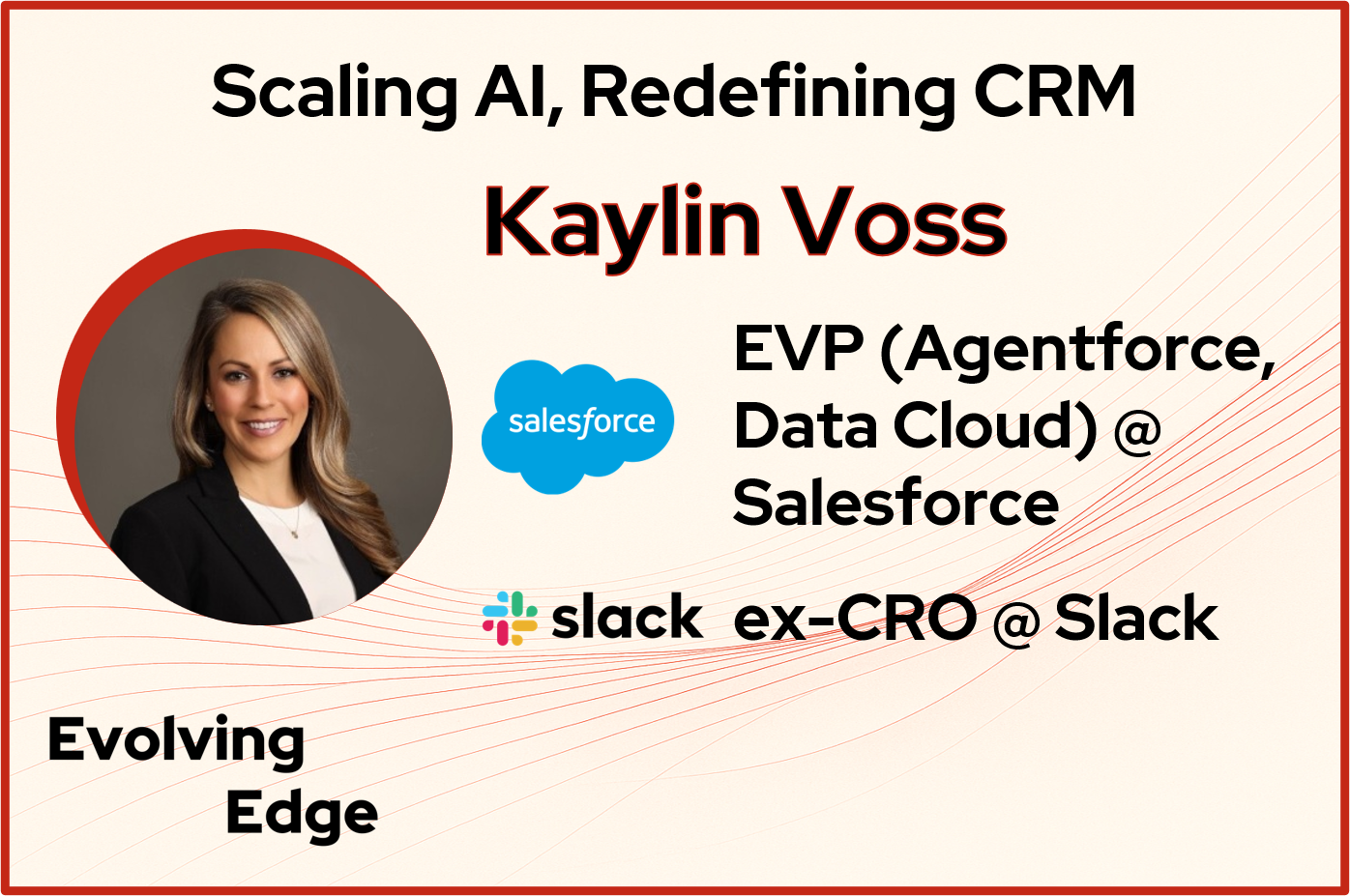
Salesforce is making a major push into AI with Agentforce - and Kaylin Voss is at the helm of its go-to-market globally. From Slack to Salesforce, she has built a career at the crossroads of enterprise software and groundbreaking innovation. Today, she leads Agentforce and Data Cloud in Salesforce, tasked with shaping how AI agents and trusted data transform the enterprise.
In this conversation, Kaylin shares how Salesforce decides which AI use cases matter, how enterprises are adopting Agentforce at speed, why CRM is evolving from management to orchestration, and how the GTM playbook for AI looks very different from traditional SaaS.
Q: Kaylin, thanks for joining us. To start, could you share a bit about your role at Salesforce today?
Kaylin: I currently lead our global go-to-market for Agentforce and Data Cloud at Salesforce. Think of it as a startup within Salesforce - fully focused on data and AI. Nine months ago, this team didn’t exist. After Agentforce launched, Marc [Benioff] quickly realized we needed a dedicated go-to-market team. My role is to build and lead that.
I bring a mix of experiences to this role: CRO at Slack, where I focused on bringing consumer-grade technology into the enterprise; senior leadership at Tableau and Salesforce core. Together, that background helps me drive Salesforce’s push into AI and data with Agentforce and Data Cloud.
Q: Many companies debate whether to build AI for the sake of AI. How do you decide which use cases are truly worth pursuing?
Kaylin: My job is to identify which AI use cases truly move the needle. For companies still debating, my advice is simple: just start. Even failed experiments create valuable learning.
At Salesforce, we filter everything through “ROI-in versus agent-out.” Instead of building features because they look cool, we start by asking: what customer pain point are we solving? Contact centers that frustrate consumers, healthcare systems that create friction, financial services that are slow to resolve issues - these are the places where AI can create real impact.
Most companies begin with “efficiency AI” - reducing cycle times by 20–30%. But the more exciting shift is to “growth AI.” That’s when AI enables work that humans couldn’t cover before. At Salesforce, our digital SDR agents now nurture leads that previously went untouched. That’s entirely new revenue. Customers like ADECCO and Indeed are seeing similar results: digital labor capturing signals 24/7, driving growth instead of just efficiency.
Q: Enterprises often move cautiously with new technologies. How do you convince them to adopt AI, given the speed and risks involved?
Kaylin: Trust is the foundation. Enterprises demand compliance, governance, and security guardrails - and that’s exactly why they adopt AI with Salesforce. Their workflows, data, and applications are already embedded in our trusted platform.
We see enterprises start with assistive, lower-risk use cases: internal knowledge management, basic automation, agent copilots. Once they see value and trust the safeguards, they expand toward more autonomous use cases. And while enterprises are careful, the pace of adoption has been faster than many expect. Once they feel secure, they scale quickly.
Q: What will CRM look like five years from now in the age of AI?
Kaylin: CRM will evolve from customer relationship management to customer relationship orchestration. Instead of static databases, AI agents will be proactive partners.
In the old world, reps looked up records, typed in notes, and manually updated pipelines. In the new world, agents capture insights automatically, log data in real time, and proactively recommend next best actions - from highlighting churn risks to suggesting upsell opportunities. The interface will be conversational and multimodal, guiding users instead of burdening them with data entry. Paradoxically, people will spend more time in CRM, but in a more productive, value-adding way.
DIY solutions often fall short because they can’t provide observability or measurability at scale. Companies need to know how their human reps and AI agents are performing side by side. That’s where we see Agentforce winning: deep workflow integration plus enterprise-grade observability.
Q: You’ve led GTM across Slack, Data Cloud, and now Agentforce. How does the go-to-market motion differ for AI products?
Kaylin: It’s a fundamentally different motion. Traditional SaaS sales is linear: pre-sales, close the deal, hand off to customer success. With AI, it’s fluid and ongoing - you never “win” or “lose” a customer, because there’s always another workload or use case to unlock.
We call it the “accordion principle.” You start with a big, strategic vision, then narrow to a simple, practical use case. Once that lands, you expand again. Success begets success.
This also demands new talent. Seventy percent of my top performers today come from engineering or architecture backgrounds. They’re not just sellers - they’re co-builders. Workshops are the new demo. Instead of showing slides, we sit with customers, deploy agents into production, and refine them week by week.
And the buyer set is broader. In the past, you sold CRM to business owners and IT. Now, it’s everyone: COO, CMO, CTO, CDO, Chief Product Officer. AI touches every function, so we call it an “all-motion” go-to-market.