

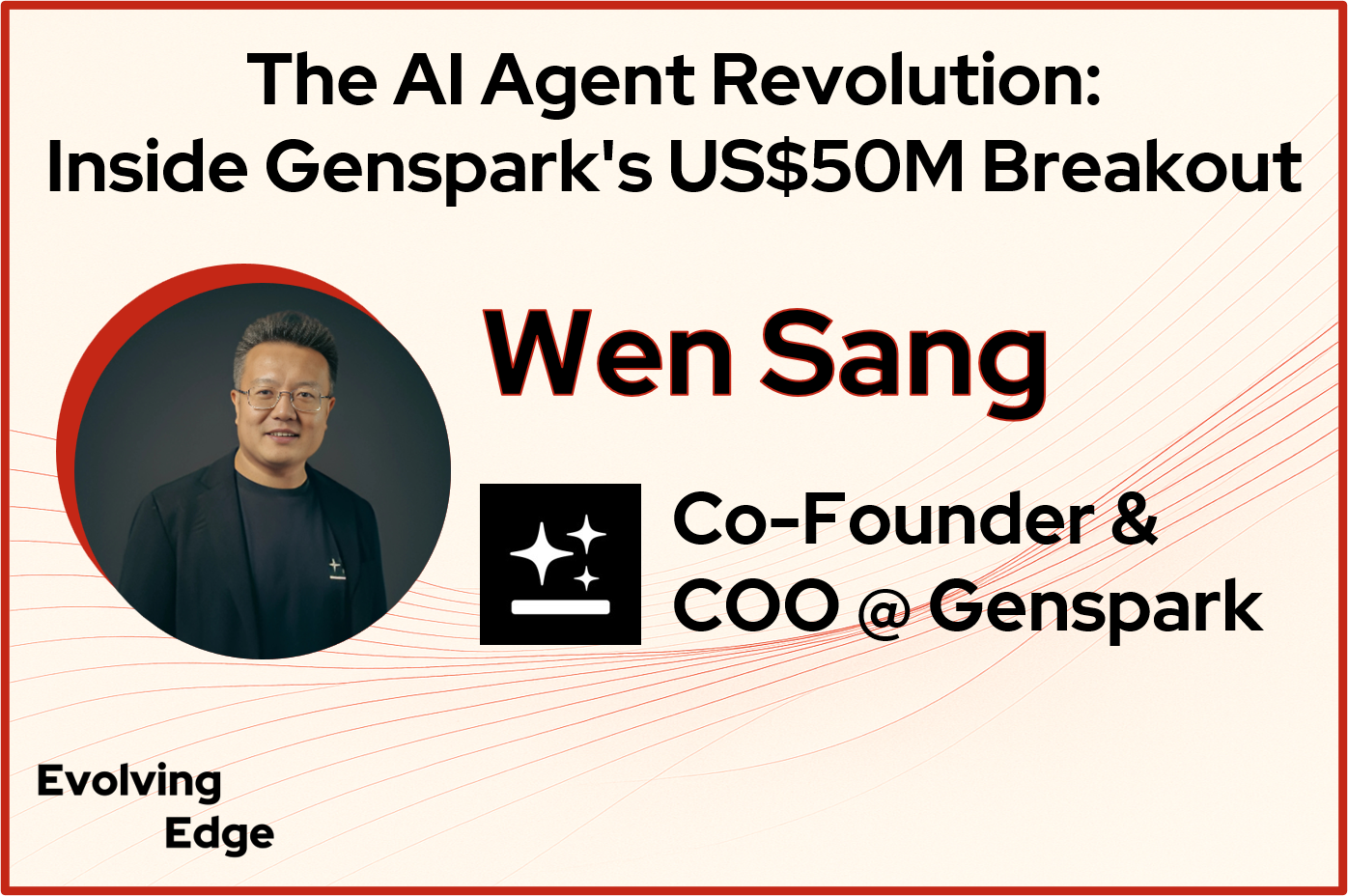
Genspark is one of the fastest-scaling AI startups of 2025, hitting US$50M ARR in just five months! Co‑founder and COO Wen Sang talks about how Genspark evolved from a search startup into one of the most talked‑about agentic AI companies today - and what it takes to build something enduring in one of tech’s fastest‑moving markets.
Q: Wen, could you start by sharing your journey before Genspark - and how the company came about?
Wen: I’m an engineer by training - I got my PhD from MIT back in 2013. After that, I started my first company, an enterprise SaaS platform that helped municipalities and commercial real estate owners manage their parking assets. The company backed by Y Combinator, Khosla Ventures, and a few others, before it was acquired. I stayed on for about a year, then left in 2023 - around the time I met my co-founder Eric Jing.
Eric had just moved to Silicon Valley, and we got introduced by a mutual friend. We became friends first, then co-founders. I was actually working on building a car at the time, but after a few conversations with Eric, it was clear there was a much bigger wave happening in AI. That’s how Genspark began.
Q: What was the early vision - and how did it evolve into the super agent suite?
Wen: Our first product was actually focused on search. Eric had deep experience in that space, and we wanted to build the next generation of search technology.
We reached about five million users, but we quickly realized that the future of search wouldn’t be about search itself. Access to information was becoming so cheap and abundant that it would be hard to build lasting value around it.
So we asked ourselves a simple question: Why do people seek information in the first place? Most of the time, it’s to get something done. That led to the idea of going a step further - rather than just giving people information, could we help them actually complete the task?
That’s how our super agent suite was born earlier this year. Within five months of launch, we hit US$50M in ARR - a sign that the world was ready for this shift.
Q: That’s remarkable growth. How do you think about standing out from so many AI agents launching globally?
Wen: Honestly, we don’t think much about competition right now. The majority of the world is still catching up to what AI truly is - most people are just starting to experience its potential.
For us, the focus has always been the product. What really differentiates us is the quality of the output. Users are smart - they know if an AI tool actually saves time or just creates more work.
We design for what I call the “one-shot outcome.” People should feel like they can issue a command, get the result they need, and move on. That reliability and accuracy are what drive adoption. Within minutes, users see value - and that’s what keeps them coming back.
We also ship new products every week. Constant innovation is the only way forward in this space.
Q: Some people say in AI, the “loudest” players often win. How do you approach go-to-market and visibility?
Wen: Our growth so far has been entirely organic, fueled by genuine word of mouth. When something truly delivers value, people naturally share it - that’s the most authentic marketing signal you can get.
In the early days, we kept marketing intentionally light to test if product-led demand would hold on its own. When we saw that it did, we started introducing community programs, creator partnerships, and selective awareness campaigns to amplify the buzz.
Rather than chasing attention, our philosophy has been simple: build something people love so much they tell others about it.
Q: Churn and retention are common questions for consumer-facing AI products. How do you think about that?
Wen: It’s something we watch very closely. Our recent monthly paid retention has held steady at 88–92%, which is strong for an individual-user product - especially one that began fully consumer-focused. But retention isn’t just about percentages; it reflects how essential the product becomes in people’s daily routines.
Still, the core driver remains simple: product quality. If the output is fast, reliable, and genuinely saves time, users stay. Retention can’t be “fixed” through marketing; it’s earned through building consistent, dependable value over time.
Q: Margins in AI are a big talking point. How do you view the economics of running agentic products?
Wen: It’s fair to say margins in AI are messy right now - it’s still the Wild West.
On one hand, inference costs have dropped dramatically and we expect them to continue trending down, eventually close to electricity costs.
On the other hand, we run a hybrid architecture that balances closed-source and open-source models. We built a model-orchestration layer that intelligently routes different tasks to different models.
That, combined with our scale - we’re processing over a trillion tokens a month - gives us preferred rates with providers like OpenAI and Anthropic.
So while we’re not optimizing purely for margins right now, efficiency improves naturally with volume. For us, the priority remains the same: optimize for quality first.
Q: When you think about the future of work through this lens - what does it look like?
For most of history, humans were the “production machines.” We learned to use tools, then did the work ourselves.
Now, with super agents, the workflow flips. You delegate, the agent does 80–90% of the work, and you add the final touch. It’s like having a team of analysts in your pocket.
No one complains that washing machines took laundry jobs away - they just made life better. AI will be the same. It’s not about replacing people; it’s about elevating everyone’s potential.